Negligent security is when a property owner or manager fails to take reasonable precautions to safeguard guests, customers, or clients. If you were a guest, customer, or client on someone else’s property and you suffered injuries due to a criminal attack, you may have a viable negligent security claim. A negligent security claim is a way for a person to get fair compensation for the injuries that person suffered. If a person dies because of his or her injuries, then the cause of action available to the deceased person’s loved ones is wrongful death. Therefore, if a criminal killed your loved one on a business premises due to the negligence of the owner or manager of the property, you may have a claim for wrongful death.
Florida Negligent Security Law
Negligent security is a type of premises liability claim. In other words, the lawsuit is based on a person getting injured on another person’s property due to the negligence of the property owner or manager. Negligent security law in Florida is a way for a victim of a criminal attack to get monetary compensation for his or her injuries. When someone is the victim of a violent crime, pursuing a civil action against the criminal will not compensate the victim for even a fraction of the losses he or she sustained as a result of the attack. Although some criminals may be ordered to pay a victim restitution, the victim would not be compensated for his or her past and future pain and suffering, lost wages, or loss of future earning capacity. Moreover, even if the victim sued the criminal personally, a criminal rarely has the financial capacity to adequately compensate the victim for the victim’s damages. However, businesses and landowners typically are required to have sizeable commercial liability insurance policies, and this is how negligent security claims can provide justice.
If a criminal attack occurs on a business or landowner’s property, the attack may have occurred due to the landowner’s failure to provide adequate security on the premises. Assuming the landowner behaved negligently, the landowner would be responsible for compensating the victim for the victim’s injuries and damages. Therefore, if you have suffered a criminal attack on the property of a business, like a hotel, bar, club, restaurant, business parking lot, or an apartment complex, you may be entitled to compensation under Florida negligent security law. In 2026 our team achieved a $10+ million negligent security verdict for a client. These cases are complex and require a team with experience!
What is Negligent Security in Florida?
For negligent security claims, a victim of a criminal attack can allege that a business establishment, property owner, security company, or transportation company was negligent by failing to take reasonable precautions to protect people on the property from violent criminal attacks. Generally speaking, landowners and business owners owe a duty to provide adequate security measures to the people they invite onto the premises.

If a landowner or a business negligently fails to use security devices or provide adequate security measures on their property, then victims of criminal attacks on that property would likely have grounds to bring a lawsuit for negligent security. Any violent crime, including an assault, rape, stabbing, shooting, abduction, kidnapping, or robbery, could serve as the basis for a negligent security case. If the victim has a viable negligent security case, the victim may be entitled to compensation for any physical and psychological injuries sustained in the criminal attack.
Each landowner or business has a unique premises. Thus, the appropriate precautionary measures could vary, depending on the property and the location. Some of these basic security measures that landowners and business owners should have in place could include any of the following:
- Functioning fences and gates;
- Security guards;
- Functional locks on doors;
- Security alarms;
- Surveillance cameras;
- Proper lighting in stairways, parking lots, and hallways; or
- Restricted access to the premises.
Negligent Security Examples
There are many ways a person may get harmed because a landowner or business owner did not take reasonable precautions to ensure the safety of guests on the property. Here are some of the more common examples of victims of criminal attacks that could have a winning negligent security case.
- A guest who was attacked at a resort, hotel, or motel;
- A customer attacked at a convenience store, bar, club, movie theater, or retail store;
- An employee attacked at a job site or office building;
- A passenger attacked on a train, bus, plane, or cruise ship;
- An employee or a patient attacked at a medical facility, hospital, or clinic;
- A tenant who is attacked at his or her apartment or condominium complex; or
- A ticketholder who is attacked at a sporting event, casino, concert, or amusement park.
Negligent Security Lawsuit in Florida
Each state has its own laws regarding negligent security cases. However, most states have a few specific requirements or “elements” a plaintiff must prove to win his or her case. In order to win a negligent security lawsuit in Florida, a victim must prove the following four (4) elements:
- The victim was lawfully on the premises at the time of the attack;
- The premises had inadequate security measures;
- The criminal act that injured the victim was reasonably foreseeable; and
- The victim suffered harm as a result.
Note the “and” in the list of elements above. This means that a victim must prove each and every element by a preponderance of the evidence. We will talk about each of the elements of negligent security in more detail below.
Element 1: Lawfully on the Premises
The first element in a negligent security case is proving that the victim was lawfully on the premises. This determination is typically governed by whether the victim was on the property with the permission of the landowner. For example, if a person over the age of 21 enters a bar, sits down, and has a drink, the person is lawfully on the premises. Similarly, if a person pays for a hotel room, that person is lawfully on the premises of the hotel.
Classifying the visitor to a property is a major factor in all premises liability cases, including negligent security cases. Under Florida law, a landowner or business owner does not owe the same duty of care to every person who enters the property. Instead, the duty a landowner or business owner owes to a visitor depends on the relationship between the landowner and the visitor to the property. This legal relationship is defined under each state’s laws and is typically based on the reason the visitor entered the property and whether that visitor had permission to enter the property. Florida law classifies visitors as invitees, invited licensees, uninvited licensees, known trespassers, and unknown trespassers.
Invitee
An invitee is a person invited onto someone else’s property for public or business purposes. In other words, the invitee is on the property for the landowner or business owner’s benefit. A common example of an invitee would be a customer in a convenience store or a customer at a bar.
A landowner or business owner owes the highest duty to invitees. Specifically, the landowner owes a duty to invitees to keep the premises in a reasonably safe condition and correct or warn of dangers that the owner knew of, or should have known of, and which the invitee did not know of or should not have known of through the use of reasonable care.
Invited Licensee or Social Guest
An invited licensee is a person who enters someone else’s property for a social purpose and with the permission of the landowner or business owner. In other words, an invited licensee is a social guest. For example, a guest at a holiday party or a guest at a social event would likely be considered a licensee.
The duty a landowner or business owner owes to an invited licensee is the same duty of reasonable care owed to invitees. Specifically, a landowner or business owner owes an invited licensee a duty to exercise reasonable care in maintaining the property in a safe condition.
Uninvited Licensee
An uninvited licensee can be thought of as a person whose presence is neither sought nor forbidden, but whose presence is tolerated by the landowner. An example of an uninvited licensee might be a door-to-door salesman.
The only duty a landowner owes to an uninvited licensee is to avoid willful or wanton harm to the uninvited licensee and, upon discovery of his presence, to warn the uninvited licensee of any known dangers which would not be open to its ordinary observation. For example, a property owner would be required to remove a concealed condition or hidden trap that the owner has actual knowledge of to avoid causing harm to the uninvited invitee.
Known Trespasser
A known trespasser is a person who enters the landowner’s property without permission, and the landowner knows that the trespasser enters the property. An example of a known trespasser would be a person who jumps a fence and crosses the landowner’s property on occasion to get to the other side.
Under Florida law, the duty a landowner owes to a known trespasser is to refrain from grossly negligent acts or intention harm and warn the known trespasser of conditions that are not readily observable. Thus, if there is a hidden and dangerous condition on the landowner’s property, the landowner should warn the known trespasser of the dangerous condition. For example, if the landowner had land mines hidden on the property (I know, it’s a hypothetical), the landowner must warn the known trespasser of the mines.
Unknown Trespasser
An unknown trespasser is a person who is unlawfully on someone else’s property. In other words, an unknown trespasser is a person who enters the premises without the landowner or business owner’s permission. For example, a person who sneaks onto another person’s property without permission would be considered an unknown trespasser.
The duty a landowner or business owner owes to an unknown trespasser is less than the duty owed to an invitee or licensee. Specifically, a landowner or business owner owes an unknown trespasser a duty to exercise reasonable care to avoid reckless or intentional injuries to the unknown trespasser. For example, a landowner or business owner may be liable if the property owner injures an unknown trespasser with a trip cord, spring gun, or some other dangerous trap.
Element 2: Inadequate Security Measures
The second element in a negligent security case is proving that the landowner or business failed to take adequate security measures to avoid harm to guests on the property. A major factor in proving whether a landowner failed to take adequate precautionary measures is the type of property where the criminal attack occurred. For example, in parking lots and garages, inadequate lighting or the absence of security guards could be used to prove negligent security. Similarly, bars and clubs with a history of violence would likely require bouncers or other security personnel to remove violent customers who are a risk to innocent bystanders. In addition, negligent security may be proven by showing the property had unlocked doors, a broken window, a broken gate, no security cameras, and/or security cameras that were not working at the time of the attack.
Videos and photographs can provide some of the best evidence of inadequate security on a property. If the property had working surveillance cameras, a negligent security attorney could use the footage to show that a criminal was able to gain access to a premises through a broken window, unlocked door, or defective gate or fence.
Additionally, during the discovery phase of a lawsuit, a negligent security attorney can obtain other useful evidence of security measures that were inadequate at the time of an attack. For example, during the property owner’s sworn deposition, the attorney could ask whether the business had surveillance cameras, whether they were working at the time of the criminal attack, and whether the owner had a video of the attack. If the business owner responds that the surveillance video cameras were not working at the time, the owner’s deposition testimony may provide strong evidence of inadequate security measures on the property. The attorney may also be able to obtain records from the business owner regarding repairs, maintenance, and malfunctions of the surveillance cameras, which show that the cameras were defective at the time of the criminal attack.
Element 3: Foreseeability
The third element in a negligent security case is proving that the criminal attack was foreseeable to the landowner or business. In Florida, a landowner must have reasonably foreseen the criminal activity to be liable for a victim’s harm. Thus, foreseeability is the critical element in many negligent security cases.
Generally, a landowner in Florida does not have a duty to protect a person from a third-party criminal attack. However, the exception to this rule is when a landowner should have anticipated the type of criminal activity that occurred on the property. When deciding whether a property owner should have anticipated the particular criminal activity, Florida courts usually consider the following factors:
- The specific criminal offense that occurred;
- The frequency of criminal offenses on the property;
- When the criminal offenses occurred; and
- Whether the criminal offenses occurred on or near the property in question.
When prior criminal attacks occurred near the place and time of a victim’s attack, property owners are more likely to be held liable. A victim’s negligent security case is stronger if there were multiple prior criminal attacks on the property that were similar to the one that injured the victim. For example, a jewelry store owner may be deemed to have reasonably foreseen attacks and robberies in the parking lot if the owner knew that other people had been robbed in the parking lot after purchasing jewelry in the owner’s store.
Proving foreseeability often involves researching prior crimes on or in the vicinity of the property. Often, the best evidence of prior crimes is found in police reports and news articles about prior crimes in the area or on the business premises. Police reports and news articles also provide the date, time, location, and type of prior crimes that have occurred on or near the subject property. For example, where a patron suffers a violent attack outside of a nightclub, there can be news articles discussing other violent crimes that occurred at that same nightclub months before. This type of evidence can be excellent evidence that a subsequent criminal attack was foreseeable.
Other examples of valuable evidence in proving foreseeability in a Florida negligent security case may include some of the following:
- Social media posts of criminal activity;
- Reviews and comments about security measures on the property;
- Incident reports created by the property owner regarding crimes on the property; and
- Prior insurance claims by the property or store owner related to criminal attacks.
Element 4: Harm
The last element in a Florida negligent security case is harm. Essentially, if a person suffers injuries, the element of harm is satisfied. Most people who are victims of criminal attacks suffer physical and psychological injuries. Therefore, harm is generally one of the easiest elements to prove.
Compensation in Florida Negligent Security Cases
The compensation will be different for each negligent security case, based on the damages to the victim and the unique facts of the case. However, there are some general categories of damages that a victim of negligent security could be compensated for. A victim of a criminal attack who brings a negligent security lawsuit may receive monetary compensation for the following types of damages.
Medical Bills
A victim of negligent security may receive compensation for past and future medical bills. A victim’s medical bills may include bills from hospitals, doctors, chiropractors, physical therapists, and mental health specialists, as well as any costs for prescription medications. For example, a victim may be entitled to medical expenses for the treatment of traumatic brain injuries, cuts and lacerations, bruises, fractures, gunshot wounds, stab wounds, or any other physical injuries that result from a criminal attack. The records from a victim’s medical providers assist with proving the type and extent of the victim’s physical and mental injuries.
Lost Wages
Lost wages would include money lost as a result of missing past and future work. For example, if the victim of negligent security had to spend time in the hospital after the criminal attack, the victim would have lost past wages because he or she would have missed work. Similarly, if the victim’s injuries prevented the victim from going to work in the future, that loss would be classified as lost future wages.
Lost Future Earning Capacity
A victim of negligent security may be entitled to compensation for lost earning capacity if the victim lost earning capacity as a result of his or her injuries. For example, if a person suffered brain injuries and was unable to finish school, that person would lose the ability to earn extra income in the future, and those damages would be compensable as lost future earning capacity.
Pain and Suffering
Physical and psychological pain and suffering are a big part of compensable damages in a negligent security case. Physical injuries cause pain, and the psychological trauma of a criminal attack can cause severe emotional distress and a lifetime of anxiety. These types of damages are compensable in a winning negligent security case.
Property Damage
In addition to the harm caused to the victim themselves, there may be damage to the victim’s property as well. For example, the victim may lose his or her glasses, laptop, or smartphone as a result of the criminal attack. If that is the case, the victim may be entitled to the cost of repair or replacement of the items lost or damaged.
Statute of Limitations for Negligent Security Claims in Florida
The statute of limitations provides the time limit that a person can bring a negligent security lawsuit against a landowner or business owner. Each state has its own unique statute of limitations for negligent security cases. In Florida, a victim of a criminal attack has two (2) years from the date of injury to bring a negligent security lawsuit. Thus, if you were the victim of a criminal attack on someone else’s property, you should contact a nearby attorney right away to make sure your rights are protected.
bouncer assault lawyer
Bouncers are employed by bars and clubs as a primary security measure to maintain order and protect patrons from foreseeable harm, such as fights or unruly behavior. However, when a bouncer uses excessive or unnecessary force, their conduct may cross the line from professional security into criminal assault. Under Florida law, if a bouncer’s aggressive behavior causes injury to a lawful guest, the business or property owner may be held liable for negligent security.
A bouncer assault lawyer can assist victims by gathering essential evidence—such as surveillance footage and police reports—to prove that the business failed to provide adequate security. By filing a negligent security claim, an attorney helps victims seek compensation for medical bills, lost wages, and the pain and suffering resulting from the encounter.
2026 Negligent Security Verdict in Florida - $10 Million Jury Verdict Win
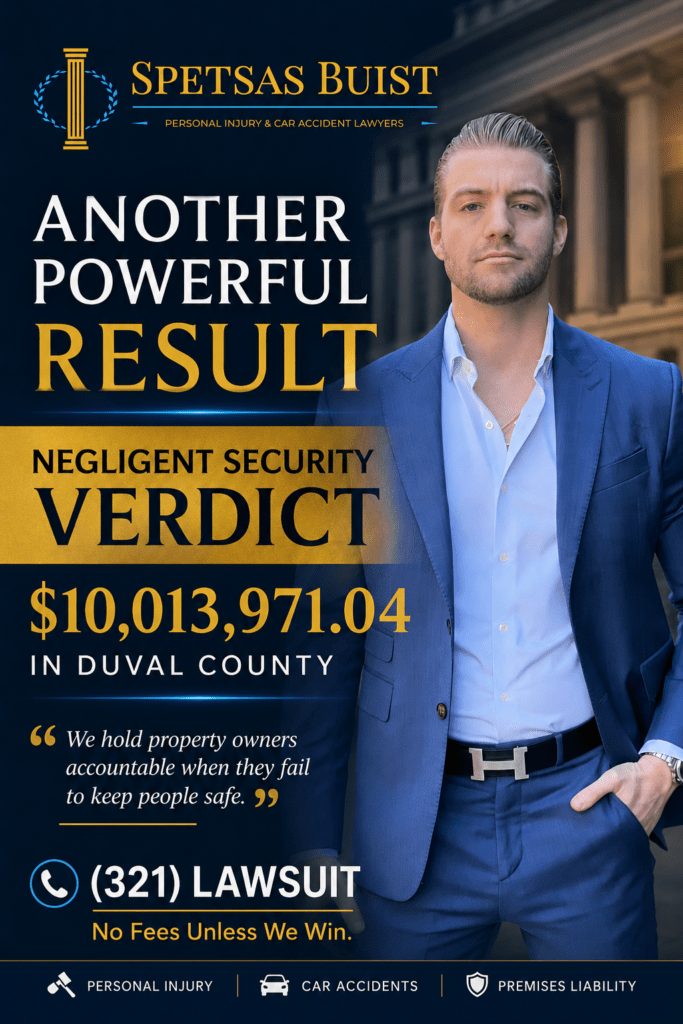
Our team at Spetsas Buist Personal Injury & Car Accident Lawyers is proud to announce that we secured a $10,013,971.04 jury verdict on behalf of our client, who suffered catastrophic injuries after being shot four times at a Jacksonville, FL apartment complex. The case went to trial, and Nick Spetsas served as lead trial counsel. The jury returned a verdict on June 1, 2026, in the Circuit Court of the Fourth Judicial Circuit in and for Duval County, Florida.
The case involved a negligent security claim against Garamor, Inc., the owner of La Estancia Apartments property, and Kunarquen RE LLC, which is the property's management company. Following a jury trial, the jury found the defendants fully responsible for the injuries and awarded our client more than $10 million in damages.
How much compensation you receive for a negligent security jury verdict in Florida varies based on the unique circumstances of each situation and the severity of your injuries. Based on our own data on this page, the average negligent security verdict could be up to $10+ million.
A Life Nearly Lost Because of Negligent Security in Jacksonville
On August 18, 2023, our client was lawfully present at La Estancia Apartments in Jacksonville when an unknown assailant attacked him and shot him. Our client sustained four gunshot wounds to the chest. Despite his injuries, our client managed to leave the property before crashing his vehicle in front of police officers.
He was subsequently rushed to a Jacksonville trauma center in critical condition. Shortly after arriving, our client’s heart stopped, and he required an emergency open-chest resuscitation procedure in the emergency room to be revived. Medical professionals were able to manually revive our client’s heart after several minutes of cardiac arrest.
What followed was an extraordinary fight for survival on our client’s part.
To save our client’s life, he underwent four major surgeries over the course of sixteen days and subsequently remained hospitalized for twenty-nine days, including eighteen days in the intensive care unit. Although he survived, the shooting left our client with permanent and life-altering injuries that continue to affect every aspect of his daily life.
Catastrophic Injuries and Permanent Consequences
The injuries our client sustained in this shooting at the La Estancia Apartments were severe. Medical evidence that we presented during trial demonstrated that he suffered damage to multiple vital organs and internal structures, including his:
- Heart
- Diaphragm
- Stomach
- Spleen
- Lung
Our client also experienced cardiac arrest and sustained injuries to a major coronary artery. He underwent significant and multiple chest and abdominal surgeries in an effort to save his life. As a result of his injuries, our client lives with:
- Chronic daily back pain
- Ongoing chest and abdominal pain
- Post-traumatic migraines
- Pulmonary fibrosis
- Permanent disfiguring scars
- Reduced mobility and physical function
- Long-term pain and suffering
The evidence we submitted on our client’s behalf showed that many of these health and chronic pain conditions are permanent and will continue to impact them for the rest of his life. We anticipate future medical treatment, including orthopedic spine and thoracic consultations, as well as possible surgeries.
How Attorney Nick Spetsas Won This Negligent Security Premises Liability Verdict Amount
This case was not about holding the unidentified shooter accountable, but rather the property owners and the property management company. After reviewing evidence and identifying liable parties, our team revealed the negligence of the property owners and managers. It is their responsibility to provide reasonably safe premises for residents and lawful visitors.
This conclusively established several key facts in the case, including:
- Negligence
- Inadequate security measures
- Foreseeability of the attack
- Causation
The defense wanted to focus the jury on the shooter, while we urged the jury to focus on why the shooter chose this particular apartment complex to commit a crime. Our argument was simple: The shooter went to this property to commit a crime for the same reason other criminals had committed violent crimes on the property.
Criminals commit crimes on properties where they think they can get away with it, properties that don’t have reasonable security measures in place. When you manage a property that attracts criminals, you make everyone in the community less safe; you strain the police and taxpayer dollars; and you destroy the value of neighboring properties. It’s irresponsible, and only the landowner benefits.
The Jury's Verdict
After hearing the evidence that we presented in court, the jury awarded our client a total of $10,013,971.04. The verdict included compensation for:
- Past medical expenses: $98,617.04
- Future medical expenses: $369,354.00
- Past pain and suffering, disability, disfigurement, and loss of enjoyment of life: $610,800.00
- Future pain and suffering, disability, disfigurement, and loss of enjoyment of life: $8,935,200.00
The Duval County jury also determined that the unidentified assailant's conduct was not a contributing legal cause for purposes of apportioning fault in the case. As a result of this decision, no fault was allocated to the shooter, and the property owner and property manager were held fully responsible for the entire jury verdict.
NOTE: The defense banked on the jury attributing fault to the shooter, but the jury was onto their game from the beginning. They understood that the criminal system punishes the shooter, and the landlord can only be held responsible via the civil system.
Why Holding Negligent Security Offenders Liable Is Important In Florida
Apartment complexes, shopping centers, hotels, parking garages, and other commercial properties have legal obligations to address known safety risks and take reasonable steps to protect those who are on their premises from foreseeable criminal attacks.
When property owners ignore foreseeable dangers, fail to implement appropriate security measures, or neglect the fact that there is known criminal activity, innocent people can suffer devastating injuries or even lose their lives. Negligent security cases in Florida often arise from incidents involving:
- Apartment complex shootings
- Assaults and batteries
- Armed robberies
- Parking lot and parking garage attacks
- Attacks at gas stations and convenience stores
- Inadequate lighting
- Broken gates or access controls
- Failure to hire or maintain security personnel
- Failure to address known criminal activity on the property
Negligent security cases are a type of premises liability under Florida law. These types of cases can be legally complex and often require:
- Extensive investigation
- Expert testimony
- Aggressive litigation
Holding negligent property owners accountable for not having safe premises can help injured victims obtain the financial compensation they need for ongoing medical care and future recovery costs. It can also force a landowner or business to clean up their property, make it safe, and act responsibly.
How Spetsas Buist Personal Injury & Car Accident Lawyers Helps Injury Victims
The result in this case, obtained by lead trial counsel Nick Spetsas, reflects our firm's commitment to pursuing justice for people whose lives have been permanently altered by another person or party’s negligence. Catastrophic injury cases like this one frequently involve substantial medical treatment, future care needs, insurance disputes, and attempts by defendants to avoid both social and financial responsibility. Our team of Florida personal injury lawyers works diligently to build strong cases that are supported by:
- Evidence
- Medical records
- Expert analysis
- Thorough investigation
Whether a personal injury case we take on involves negligent security, a serious car accident, a trucking collision, wrongful death, or another form of personal injury, we fight tirelessly to recover compensation for all types of damages, including:
- Medical expenses
- Future medical care
- Lost income
- Reduced earning capacity
- Pain and suffering
- Disfigurement
- Permanent disability
- Loss of enjoyment of life
- Emotional pain and suffering
Every case we take is different, but our goal remains the same. We strive to help Florida injury victims pursue the compensation they deserve and hold negligent parties accountable for the harm they have caused. Most importantly, we want to make our communities safer, and that’s what negligent security cases ultimately do.
Florida Negligent Security Attorney Near You
When a business fails to act safely, the consequences for victims can be devastating. If you’ve suffered a serious injury or lost a family member as a result of a security failure, speaking with an aggressive negligent security lawyer near you in Orlando, FL, is the first step toward justice. Contact Spetsas Buist by email, or call (321) 529-7848 today to schedule your free consultation.
When you contact Spetsas Buist, you speak directly with an attorney. We provide the details you need to make an informed decision about your claim, with no financial risk to you: the initial consultation is free, we don't get paid unless you do, and we never charge interest on the costs of your case.
With direct access to your attorney, no financial burden, and a track record of success, it’s clear why so many choose Spetsas Buist. Read our reviews and testimonials to learn more.